Less
Guesswork,
More
Cognitive
Science
✳︎
Intervention
That
Works
✳︎
Consulting
That
Transforms
✳︎
Less Guesswork, More Cognitive Science ✳︎ Intervention That Works ✳︎ Consulting That Transforms ✳︎
I firmly believe that…
literacy is a fundamental civil right
everything should be rooted in equity and trauma-informed care.
the best intervention is prevention
The Problem
Across the nation, schools face a deep and persistent literacy crisis, with nearly two-thirds of US fourth graders reading below grade level. For years, Tier 1 classrooms have lacked instruction grounded in the Science of Literacy, Instructional Science, and Learning Science, too often relying on ineffective cueing methods rather than explicit modeling, schema building, spaced retrieval, and cognitive load management. Teachers are left under-resourced with patchwork tools instead of high-quality instructional materials (HQIM), navigating professional learning without sustained, job-embedded coaching. This systemic gap hits Multilingual Learners, Dual Language Learners, and Students with Exceptional Needs (including students with Dyslexia) hardest. Lacking Universal Design for Learning (UDL) frameworks, rigid programs misdiagnose linguistic differences as deficits, fail to leverage rich home languages and dialects as assets, and default to low-expectation silos that pull learners away from core instruction instead of delivering asset-based, direct multi-sensory structured literacy.
This crisis is compounded by deep structural disconnects within school systems. Without seamless P–3 vertical system integration from Pre-K through 3rd grade, students experience fragmented literacy scope and sequences that fail to systematically scaffold both sides of Scarborough’s Rope and the Simple View of Reading, leaving both foundational word recognition (phonology, decoding, automaticity) and knowledge-rich language comprehension (background knowledge, complex syntax, vocabulary, reasoning) disjointed across grade bands. Early screening tools frequently lack non-discriminatory, culturally validated frameworks, leading to delayed or inaccurate identifications. Consequently, intervention frameworks remain largely reactive, relying on isolated fixes rather than a high-performing Multi-Tiered System of Support (MTSS) capable of delivering targeted, diagnostic Tier 2 and Tier 3 interventions. Meanwhile, school systems struggle to build long-term internal capacity without cascading coaching models to support educators. Left without structured session debriefs, transparent progress tracking, or actionable home practice routines, families navigate homework stress in isolation, while students lose confidence in a system that was not built to meet their needs.
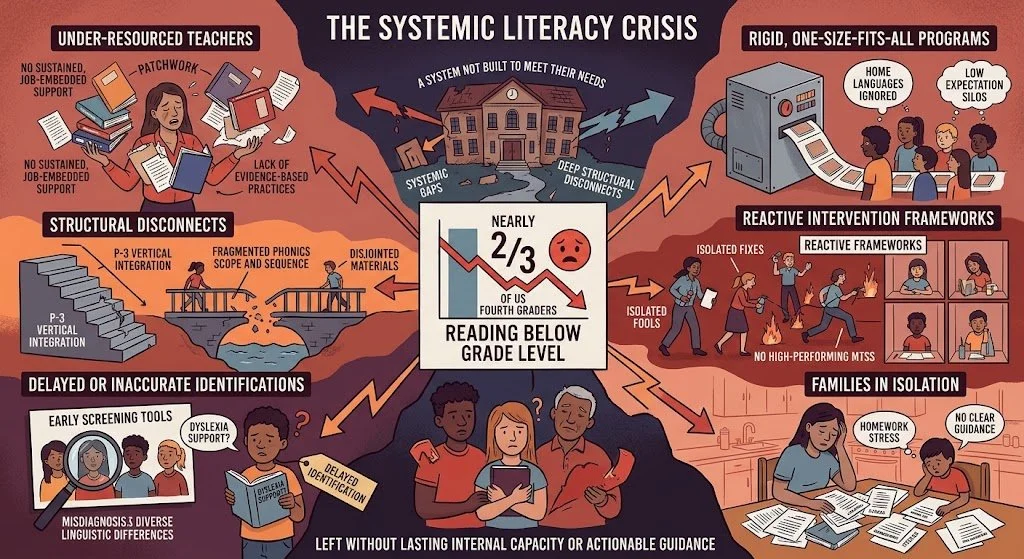
Image generated by Google Gemini, Aug 2026
My Solutions
1:1 Structured Literacy Intervention
Direct Multi-Sensory Instruction: Delivering targeted, research-backed 1:1 direct reading instruction using structured literacy models to accelerate growth and restore student confidence for young learners to adolescents.
Asset-Based & Inclusive Delivery: Supporting Multilingual Learners, Dual Language Learners, and Students with Exceptional Needs (including Dyslexia) by applying Universal Design for Learning (UDL), leveraging linguistic assets, and honoring home dialects to eliminate low-expectation silos.
Parent and Family Support
Structured Session Debriefs: Engaging families through transparent, regular post-session updates and progress tracking.
Actionable Home Routines: Providing easy-to-use home practice routines that eliminate homework stress and reinforce reading success beyond the classroom.
Literacy Consulting and Coaching
Sustainable Educator Coaching: Driving continuous improvement through job embedded teacher coaching, video analysis, and cascading coaching models to build long term internal capacity across campuses.
Comprehensive Framework Integration: Embedding the Science of Literacy, Instructional Science, and Learning Science into daily instruction, replacing ineffective cueing methods with explicit modeling, spaced retrieval practice, schema building, and cognitive load management.
Science-backed Professional Learning: Coaching educators to systematically develop both sides of Scarborough’s Rope and the Simple View of Reading by balancing word recognition like phonology, decoding, and automaticity with deep language comprehension including background knowledge, complex syntax, vocabulary, and verbal reasoning.
Literacy Systems Change
P-3 Vertical System Integration: Unifying comprehensive literacy scope and sequences, high quality instructional materials, and standards from Pre K through 3rd grade to eliminate instructional gaps across general education, special education, and multilingual pathways.
Evidence-based Learning Systems: Aligning district wide curricula with principles of cognitive science, ensuring that both foundational decoding routines and knowledge rich language comprehension frameworks are systematically scaffolded across all grade bands.
High Performing MTSS and Early Screening: Supporting local educational agencies to build a robust Multi Tiered System of Support using non discriminatory, culturally validated early screening tools to deliver diagnostic Tier 2 and Tier 3 interventions without misdiagnosing linguistic differences or pulling students from core learning.
What my clients are saying
Let’s chat!